
Business SMS Compromise: What Security Leaders Must Know

Business SMS Compromise (BSC) is a targeted social-engineering attack in which adversaries exploit SMS, iMessage, WhatsApp, or similar messaging channels to manipulate employees into authorizing fraudulent wire transfers, redirecting payroll, or surrendering credentials. Unlike generic smishing, BSC is deliberate and business-process-aware: attackers study organizational hierarchies, payment workflows, and vendor relationships before sending a single message. The defining characteristic is its dual-channel structure — an initial email establishes the pretext, then the attacker pivots the conversation to SMS or messaging to escape corporate monitoring.
When your team detects BSC indicators, the immediate priorities are:
- Preserve evidence first. Screenshot messages, note timestamps, and export delivery metadata before anything is deleted.
- Block the sender number or account at the carrier or MDM level, but do not notify the attacker.
- Notify finance and executive leadership immediately; suspend any pending payment or authorization the messages referenced.
- Contact your bank if a transfer has already been initiated — wire recalls are time-sensitive.
Pro Tip: Treat any SMS or messaging-app instruction to change payment details, reset credentials, or approve a transfer as untrusted by default. Verify through a known-good phone number from your internal directory, not from the message itself.
Table of Contents
- What is business SMS compromise and how do attackers execute it?
- Why BSC is uniquely dangerous for enterprise security teams
- How to inventory and classify every business process that uses SMS
- Concrete mitigations to reduce BSC risk across your environment
- Detecting BSC: signals your monitoring playbook is probably missing
- Incident response checklist for suspected business SMS compromise
- Policies, playbooks, and training that reduce human risk
- Key Takeaways
- The trade-offs security practitioners rarely talk about
- How Smishalert helps you detect and respond to messaging-based threats
- Useful sources for security teams
- The perspective security teams need to hear
What is business SMS compromise and how do attackers execute it?
The attack chain typically opens on email. An adversary impersonates a CFO, vendor, or IT administrator, establishes urgency, and then asks the target to continue the conversation via text — often framing it as a matter of privacy or speed. Microsoft’s BEC guidance confirms this pattern: attackers deliberately request a phone number to shift the pretext off instrumented corporate channels and onto messaging, where forensic trails are thin.
Once on SMS, attackers deploy several techniques:
- SMS spoofing: Sender names and numbers can be mimicked with minimal technical effort. SMS lacks the header metadata that email carries, so recipients have no reliable way to verify origin.
- SIM swap: Attackers use stolen PII to port a victim’s number to an attacker-controlled SIM, intercepting authentication codes and severing the victim’s access.
- SS7 interception and malware: Both allow real-time forwarding of SMS messages, including one-time passcodes, without the victim’s knowledge.
- Grey-route delivery: Cheap, untraced SMS paths through fourth-party aggregators that obscure message origin and reduce accountability.
Adversaries time these attacks carefully: payment windows, end-of-quarter closes, and executive travel schedules are all exploited. Real-world details — a vendor’s actual invoice number, a colleague’s name, a known project — reduce suspicion and accelerate compliance.
Why BSC is uniquely dangerous for enterprise security teams
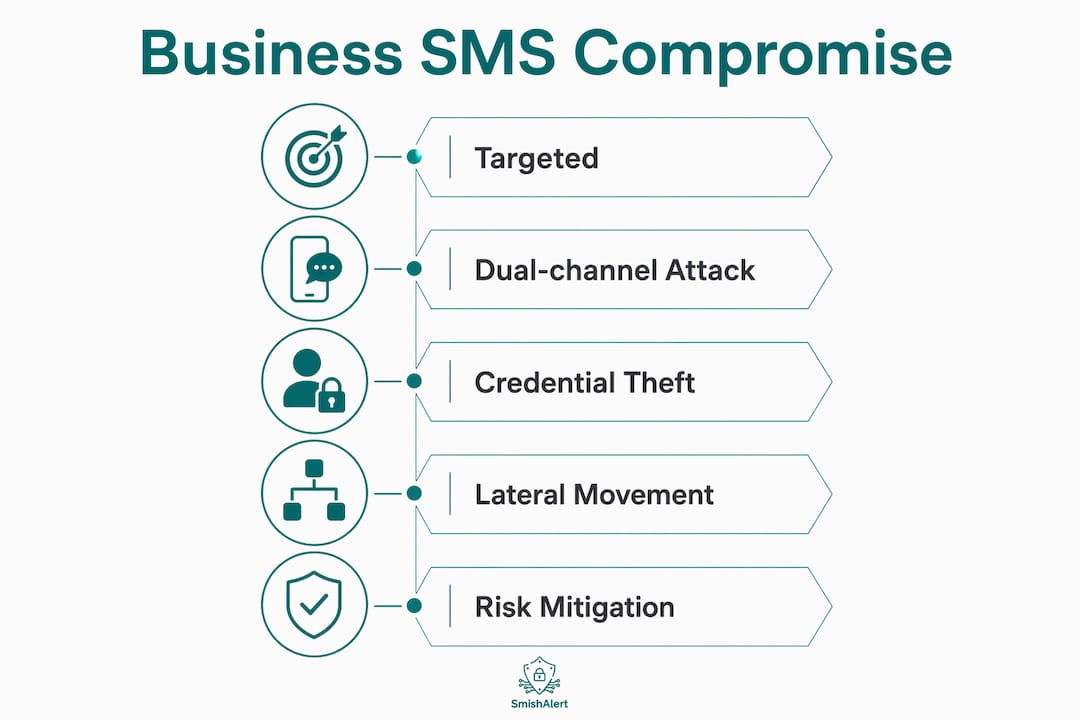
The financial exposure is direct and often irreversible. Fraudulent wire transfers, vendor payment redirection, and payroll fraud are the three highest-value outcomes attackers pursue. Wire recalls succeed only when initiated within hours; many organizations discover the loss days later.
What makes BSC particularly difficult to contain is how it sidesteps existing controls:
- Email security gateways, DLP tools, and SIEM correlation rules have no visibility into SMS or messaging-app conversations.
- There are no message headers, no sender authentication standards equivalent to DMARC/DKIM, and no corporate logging of personal messaging apps.
- Executive impersonation via SMS is especially effective because employees are conditioned to respond quickly to leadership.
Statistic: BEC financial losses continue to rise, with targeted high-value wire fraud delivering higher ROI for attackers than ransomware — making BSC economically attractive to sophisticated threat actors.
Credential theft compounds the damage. A harvested password or MFA code obtained via SMS phishing enables lateral movement, account takeover, and long-tail access that persists well beyond the initial incident.
How to inventory and classify every business process that uses SMS

NCSC guidance frames SMS as a legacy channel unsuited to high-risk authorizations and recommends classifying SMS uses before selecting controls. The practical starting point is discovery: pull vendor contracts, review MFA configurations, audit customer communication platforms, and interview finance and payroll teams. Most organizations find SMS embedded in more workflows than IT is aware of.
A simple risk-classification inventory uses five columns:
| Process | Owner | SMS Use | Business Impact if Compromised | Recommended Control |
|---|---|---|---|---|
| Appointment reminders | Marketing | Outbound notification | Low — reputational only | Standard aggregator, no links |
| Password reset OTP | IT/IAM | One-time passcode | High — account takeover | Replace with authenticator app or FIDO2 |
| Payment authorization OTP | Finance | Transaction approval | Critical — direct financial loss | Remove SMS; use hardware token + dual approval |
| Vendor onboarding confirmation | Procurement | Identity verification | High — vendor master fraud | Out-of-band call-back to known number |
| Payroll change confirmation | HR | Employee self-service | Critical — payroll fraud | Remove SMS; require in-person or portal-based verification |
Risk categories break down as follows:
- Low: Informational outbound messages with no authentication or authorization function (appointment reminders, shipping notifications).
- Medium: One-time passcodes for account login where the account itself has limited financial access.
- High/Critical: Any SMS that authorizes a payment, resets credentials for a privileged account, or confirms a change to banking or payroll data.
Concrete mitigations to reduce BSC risk across your environment
Authentication is the highest-leverage control. Remove SMS as the sole MFA factor for any process classified as high or critical. Authenticator apps (TOTP-based) are a meaningful improvement; FIDO2 hardware tokens eliminate the SMS interception risk entirely for privileged workflows.
- Out-of-band verification: For any payment or vendor-change request received via SMS or email, require a verbal call-back to a number sourced from your internal directory — never from the message. Verbal confirmation is the hardest vector for an attacker to spoof in real time.
- Dual approval for payments: No single employee should be able to authorize a wire transfer or vendor payment change based on a messaging instruction alone.
- Telecom procurement controls: Prefer Tier-1 SMS aggregators with direct mobile network operator connections. Grey-route suppliers sacrifice traceability and increase fraud risk. Require delivery receipts and full supply-chain transparency in vendor contracts.
- SIM-swap and roaming checks: NCSC recommends gathering SIM-swap and roaming indicators from mobile networks before sending high-risk SMS, and blocking delivery when IMSI roaming is detected.
- MDM and conditional access: Enforce device integrity checks for corporate apps. Monitor for jailbroken or rooted devices that bypass OS-level SMS filtering.
Pro Tip: When employees use personal devices for work SMS, the risk surface expands significantly. Review your mobile messaging policy to address BYOD scenarios explicitly.
Detecting BSC: signals your monitoring playbook is probably missing
Most SOC teams have no native visibility into SMS or messaging-app traffic. That gap is the attacker’s advantage. The signals that matter most are:
High-value detection inputs include user-reported texts (the most common early indicator), cross-channel correlation between email threads and subsequent SMS activity, anomalous timing patterns (messages arriving during executive travel or outside business hours), and executive impersonation patterns detectable through name-matching against your directory.
Telemetry gaps to close: SMS and messaging-app visibility, vendor delivery metadata, carrier roaming and SIM-swap indicators, and aggregator route data. Measuring exposure means counting how many business processes rely on SMS for high-risk steps, and tracking what percentage of employees actively report suspicious messages. The Smishalert Q2 2026 Threat Signal report provides campaign-level examples of how these patterns appear in practice.
Incident response checklist for suspected business SMS compromise
When a suspected BSC incident is identified, follow this sequence:
- Preserve evidence immediately. Capture screenshots, export message threads, and document delivery metadata before any device is wiped or account is reset.
- Suspend affected authorizations. Place holds on any pending payment, vendor change, or credential reset referenced in the suspicious messages.
- Notify finance and legal. Loop in the CFO and general counsel within the first hour; they need to assess exposure and initiate bank contact.
- Contact your bank. If a wire has been sent, initiate a recall immediately. Provide the transaction reference, amount, and destination account.
- Call your carrier. Request confirmation of whether a SIM swap occurred on affected numbers. Ask for IMSI and roaming logs covering the incident window.
- Escalate to your SMS aggregator or vendor. Request sender blocking and route tracing for the offending number or SenderID.
- Notify affected third parties. Vendors, partners, or customers whose data or accounts may have been accessed need timely notification.
- File reports with IC3, CISA, and FBI when fraud or financial loss has occurred. The FBI’s Internet Crime Complaint Center is the primary federal reporting channel for BEC-related fraud.
- Preserve message headers and correlate with email. Map the full attack chain across both channels for root-cause analysis.
- Conduct a controls gap review. Identify which inventory items and mitigations were absent and assign remediation owners with deadlines.
Policies, playbooks, and training that reduce human risk
Policy language matters. The minimum requirement: no employee may act on a payment instruction, credential reset, or vendor change received solely via SMS or messaging app without independent verification through a known-good channel. That rule needs to be explicit in finance, procurement, HR, and IT policies — not buried in an acceptable-use document.
Simulated smishing exercises — targeting finance administrators, executive assistants, and payroll staff — surface that gap before attackers do. Dual-channel simulations (a spoofed email followed by a spoofed SMS) are more realistic and more instructive than single-channel tests. Playbook drills for executives should include a scripted response to an unexpected SMS requesting urgent action: pause, do not reply, call the apparent sender on a known number.
Operationally, update vendor onboarding and payroll change procedures to remove SMS as an authorization channel. Require portal-based or in-person verification for banking detail changes. These procedural controls are harder to social-engineer than any technical filter.
Key Takeaways
Business SMS Compromise is a targeted, dual-channel attack that bypasses email controls by moving victims to unmonitored messaging channels — and the most effective defense combines process controls, out-of-band verification, and structured user reporting.
| Point | Details |
|---|---|
| Treat SMS as untrusted for high-risk actions | Never authorize payments, credential resets, or vendor changes based on SMS alone. |
| Inventory SMS uses and classify risk | Map every business process using SMS; prioritize payment and credential-reset flows for immediate remediation. |
| Close the telemetry gap | SOC teams lack native SMS visibility; add user reporting and cross-channel correlation to your monitoring playbook. |
| Out-of-band verification is the strongest control | Verbal call-back to a known directory number is the hardest vector for an attacker to spoof in real time. |
| Smishalert surfaces what email security misses | Smishalert provides cross-channel correlation, user reporting, and campaign intelligence for SMS and messaging-app threats. |
The trade-offs security practitioners rarely talk about
Removing SMS from high-risk workflows is the right call technically. Getting it done is a different problem. Finance teams resist because SMS-based OTPs feel fast and familiar; replacing them with hardware tokens introduces friction that procurement teams price as a productivity cost, not a risk reduction. The budget conversation almost always stalls until after an incident.
The practical path forward is sequencing. Start with the two or three workflows where a successful attack would cause the most direct financial loss — payment authorization and payroll changes. Make the case in dollar terms: the median BEC wire-fraud loss dwarfs the cost of FIDO2 tokens for a finance team of twenty people. That framing moves procurement faster than any threat briefing.
Strict telecom controls generate false positives. Blocking SMS when IMSI roaming is detected will occasionally catch a legitimate executive traveling internationally. Build an exception process before you deploy the control, or the first false positive becomes the reason the whole program gets rolled back. The same applies to smishing simulations: calibrate difficulty to the audience, or you will train people to distrust every message rather than to verify suspicious ones.
Stakeholder engagement works best when security leaders bring finance and procurement into the inventory exercise early. When those teams see their own workflows on the risk classification table, the conversation shifts from “why are you restricting our tools” to “what do we need to fix first.”
How Smishalert helps you detect and respond to messaging-based threats
Most email security platforms stop at the inbox. Smishalert extends visibility to the channels attackers move to after that first contact: SMS, iMessage, WhatsApp, and other messaging apps. Through structured user reporting, cross-channel campaign correlation, and threat intelligence, Smishalert gives SOC teams the telemetry they currently lack for messaging-based social engineering.
Security teams use Smishalert to surface executive impersonation attempts, credential-harvesting campaigns, and payroll fraud patterns before they result in financial loss. The platform’s solutions overview maps directly to the attack types covered in this article, and the platform capabilities page details how telemetry capture and SOC workflows integrate with existing security operations. Run the two-minute self-evaluation to identify where your organization’s messaging visibility gaps are largest.
Useful sources for security teams
- NCSC: Protecting SMS messages used in critical business processes — Primary guidance on SMS risk classification and controls, directly applicable to U.S. enterprise environments.
- NCSC: Business communications — SMS and telephone best practice — Supplier selection, SenderID governance, and supply-chain transparency requirements.
- M3AAWG: Understanding and Preventing SMS-based BEC — Technical overview of SIM swap, SS7, spoofing, and recommended mitigations from the anti-abuse working group.
- Microsoft Security: What is Business Email Compromise? — Authoritative definition and email-to-SMS pivot pattern description.
- FBI Internet Crime Complaint Center (IC3) — Federal reporting channel for BEC and wire-fraud incidents.
- CISA — Federal guidance and alerts on phishing and social engineering threats.
- Smishalert Threat Signal — Q2 2026 Smishing Report — Campaign-level examples and indicators for messaging-based social engineering.
- Smishalert: Enterprise phishing and smishing answers — Operational Q&A and detection guidance for security teams.
The perspective security teams need to hear
The security industry has spent many years hardening email. Attackers noticed. The shift to SMS and messaging is not a trend — it is a rational response to the controls organizations have already deployed. Every DMARC record, every email sandbox, every BEC detection rule pushes adversaries toward the channel where you have the least visibility.
What concerns me most is not the sophistication of the attacks. SIM swaps and SS7 exploits are real, but the majority of BSC incidents succeed because an employee received a plausible text from someone who appeared to be their CFO and acted on it. No technical control stops that without a corresponding process control. The organizations that recover fastest from BSC incidents are not the ones with the most advanced tooling — they are the ones where finance staff knew exactly what to do when a suspicious message arrived.
The inventory exercise is where most programs stall. Teams discover that SMS is embedded in numerous workflows they did not know about, feel overwhelmed by the scope, and defer action. The right response is to triage ruthlessly: fix payment authorization and payroll change flows first, document everything else, and move down the risk list systematically. Perfection is not the goal. Reducing the highest-consequence exposure is.
Recommended
- Cyber Risk: Not Just an IT Issue, It’s an SMS Security Concern Too | SmishAlert
- Protect Your Business from Smishing Attacks: Lessons from a Recent Massive Data Leak | SmishAlert
- Chinese Hackers’ Deception: An Eye-Opener for SMS Security | SmishAlert
- The Rise of SMS Blasters: A New Threat to SMS Security | SmishAlert