
SMS Threat Detection Explained for Security Teams

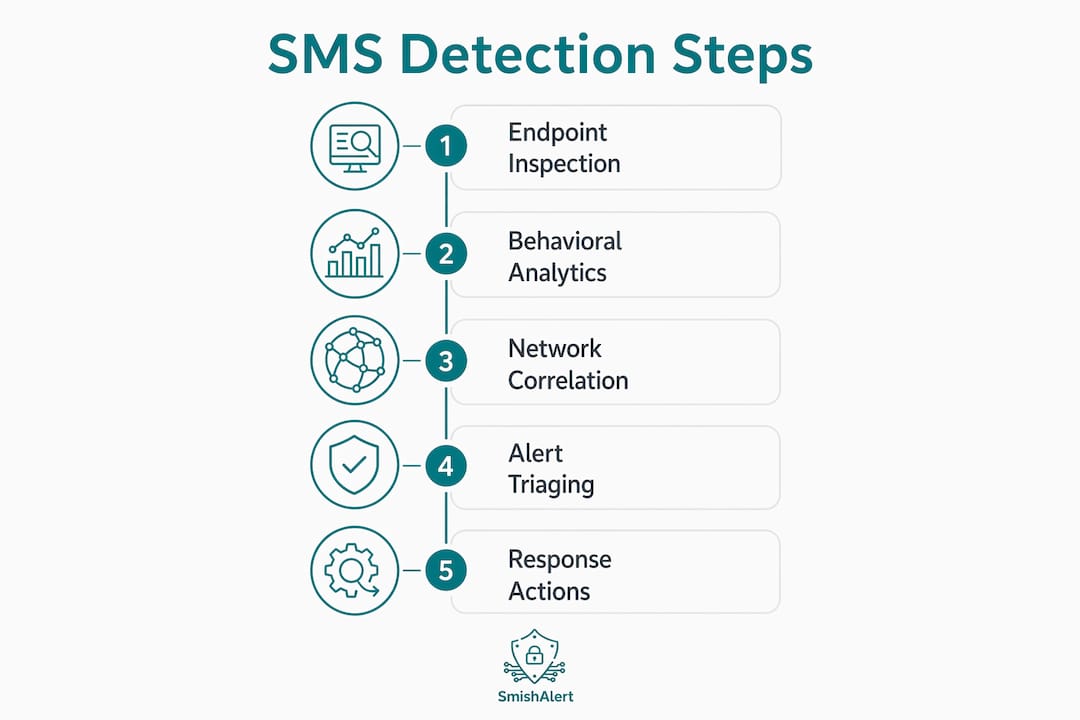
SMS threat detection is the discipline of identifying malicious or fraudulent messages targeting users through smishing, credential harvesting, and SMS fraud before those attacks result in account compromise or financial loss. With SMS fraud losses projected to reach $71 billion in 2026, and AI-driven smishing campaigns achieving click-through rates as high as 54%, the stakes for security teams have never been higher. The industry term for the broader practice is mobile social engineering detection, and SMS phishing (smishing) sits at its core. Tools like Broadcom Symantec SEP Mobile and platforms like SmishAlert address this threat through layered signal correlation, endpoint inspection, and behavioral analytics. Understanding how these mechanisms work is the first step toward building a defense that actually holds.
What signals form the basis of SMS threat detection?
No single indicator is conclusive for smishing detection. Effective SMS threat detection works by correlating multiple signals across user, session, account, and network dimensions simultaneously. FluxForce’s multi-signal correlation approach treats smishing detection as a fraud graph problem rather than simple message matching, which significantly improves detection accuracy.
The primary signal categories security teams should monitor include:
- Link analysis: Suspicious URLs embedded in messages, including newly registered domains, URL shorteners, and domains mimicking legitimate brands like Chase, FedEx, or the IRS.
- Sender anomalies: Messages originating from unexpected number ranges, virtual numbers, or numbers that have never previously contacted the recipient.
- Session sequence anomalies: Behavioral sequences such as a password reset followed by a new payee addition followed by a fund transfer, all within a 10-minute window.
- OTP consumption timing: One-time passwords consumed in under 2 seconds indicate automated credential harvesting rather than a human typing a code.
- Device fingerprinting: Authentication attempts from unrecognized devices combined with high-risk actions elevate detection confidence.
- Geographic concentration: Message bursts originating from or targeting a single geographic region outside normal operating patterns.
Correlation across these dimensions is what separates high-confidence detections from noise. A suspicious URL alone may be a false positive. A suspicious URL combined with an unrecognized device, an OTP consumed in 1.8 seconds, and a new payee added immediately after is a fraud sequence with very high confidence.
Pro Tip: Build detection rules that require at least three correlated signals before triggering a high-severity alert. Single-signal rules generate alert fatigue and cause analysts to miss genuine threats buried in noise.
How do client-side SMS inspection tools work in practice?
Client-side inspection is the first layer of SMS fraud detection techniques, operating directly on the user’s device before any interaction occurs. Broadcom Symantec SEP Mobile scans incoming SMS messages for malicious URLs and phishing content at the endpoint level, reducing dwell time by catching threats the moment a message arrives rather than after a user clicks.

The implementation differs by operating system in ways that matter for enterprise deployment planning:
| Platform | Detection behavior | Analyst workflow |
|---|---|---|
| iOS | Malicious messages moved to silent junk tab automatically | Analyst reviews SMSPhishing events in cloud console |
| Android | User receives an alert with remediation guidance | Admin notified; event logged under SMSPhishing event type |
SMS phishing events are queryable in SOC consoles under the "SMSPhishing` event type, which means analysts can triage mobile endpoint alerts within the same workflows used for email and network threats. This integration matters because it eliminates the operational gap where mobile threats go uninvestigated simply because they fall outside the standard SIEM pipeline.
One operational consideration worth noting: most client-side inspection tools scan only messages from unknown senders by default. This is a deliberate privacy design, but it means a compromised known contact, such as a colleague whose number has been spoofed, may bypass initial scanning. Security architects should account for this gap when designing layered defenses.
Pro Tip: Deploy client-side inspection tools without requiring full MDM enrollment where possible. Requiring MDM as a prerequisite for SMS protection significantly reduces adoption rates, especially for BYOD environments where employees resist full device management.
What role do behavioral analytics and timing thresholds play?
Behavioral analytics addresses a fundamental limitation of message-level inspection: campaigns can appear benign at the message level but reveal fraud clearly in authentication and transaction behaviors. A message saying “Your package is delayed, confirm your address” contains no overtly malicious content. The fraud becomes visible only when the link leads to a credential harvest followed by an account takeover sequence.
Timing thresholds validated by FluxForce include sub-10-minute multi-step fraud sequences and sub-2-second OTP consumption times. These thresholds are not arbitrary. They reflect the operational reality that human users take time to read, consider, and act, while automated fraud tools execute sequences at machine speed.
Key behavioral indicators security teams should build into detection rules:
- New payee addition followed by fund transfer under 10 minutes: This sequence is a strong fraud indicator in banking and fintech environments.
- OTP consumed in under 2 seconds: Physically impossible for a human reading a text message and typing a code. This signals automated credential harvesting.
- Unrecognized device combined with high-risk action: Device fingerprint mismatch during a password reset or beneficiary change warrants immediate scoring elevation.
- Beneficiary network graph anomalies: New payees that share account numbers or routing details with known fraud networks are detectable through graph analysis.
- Off-hours authentication bursts: Legitimate users rarely complete account changes at 3 AM. Automated fraud tools do not observe business hours.
Anomaly scoring systems that weight these signals individually and then combine them into a composite fraud score reduce false positives significantly compared to single-rule approaches. The goal is not to flag every unusual event but to surface sequences that match known fraud patterns with high confidence.
How can organizations detect large-scale SMS fraud campaigns?
Large-scale SMS fraud operates differently from targeted smishing. SMS pumping, for example, involves artificially inflating message volumes to generate revenue through premium-rate numbers, and it shows up in telemetry before it appears in complaint reports. Early fraud signals emerge in delivery and traffic telemetry rather than user complaints, which means operations teams need real-time anomaly scoring on send volume and OTP conversion rates to catch campaigns before costs accumulate.
The two most reliable operational metrics for campaign-level detection are:
| Metric | Fraud threshold | What it signals |
|---|---|---|
| OTP conversion rate | Below 20% | Messages sent to invalid or bot-controlled numbers |
| SMS send volume spike | Growth without matching user registration increase | SMS pumping or bulk fraud campaign |
Establishing quantitative baselines for SMS volume and OTP conversion is the prerequisite for detecting these anomalies. Without a baseline, a 300% volume spike looks like a successful marketing campaign rather than a fraud event. SMS firewalls and network-level detection systems add a carrier-side layer that complements application-level monitoring, particularly for detecting sequential number use and geographic concentration patterns.
Operations and finance teams need alignment here. Fraud campaigns that inflate SMS costs by thousands of dollars per hour require a response that crosses organizational boundaries. Security teams that detect the anomaly but cannot escalate to finance for cost controls lose the ability to contain damage quickly.
Pro Tip: Set OTP conversion rate alerts at the 20% threshold and review them daily during the first month of monitoring. Most organizations discover they have been absorbing low-grade SMS pumping losses for months before implementing this baseline check.
What are best practices for responding to detected SMS threats?
Detection without response is incomplete. Once a threat is identified, the response chain needs to be fast, documented, and integrated into existing SOC workflows. The following sequence reflects current best practices for SMS threat prevention strategies at the organizational level:
- Triage the alert in your SOC console. For Broadcom Symantec SEP Mobile deployments, query the
SMSPhishingevent type to pull affected devices and message content for analyst review. - Contain the affected account. If behavioral analytics flags an account takeover sequence, freeze the account and require re-authentication through a non-SMS channel before restoring access.
- Report the threat through official channels. The FTC recommends forwarding unwanted SMS to 7726 (SPAM). This feeds carrier-level enforcement and contributes to downstream defenses across the ecosystem.
- Correlate with campaign data. Check whether the sender number, URL, or message template matches other reported incidents. SmishAlert’s campaign correlation capability surfaces these patterns across an organization’s full reporting history.
- Harden identity verification. SMS-based MFA carries known vulnerabilities including SIM swap and SS7 attacks. NIST’s 2024 guidelines restrict SMS OTP for sensitive accounts and promote migration to authenticator apps and FIDO2 tokens.
- Educate the reporting user. User reporting is not just a data point. Reporting and cleanup workflows reduce victim interaction and feed enforcement ecosystems. Closing the loop with the user who reported a threat reinforces the behavior you want to see repeated.
Integrating SMS threat signals into your SIEM and IAM platforms closes the visibility gap that attackers exploit when they know mobile threats are handled separately from network and endpoint threats. The SMS blaster threat vector is a concrete example of why this integration matters: blasters bypass carrier filtering entirely, making endpoint and behavioral detection the primary line of defense.
Key takeaways
Effective SMS threat detection requires layered correlation across endpoint inspection, behavioral analytics, and network-level telemetry, with no single signal sufficient for high-confidence detection.
| Point | Details |
|---|---|
| Multi-signal correlation is required | Combine link analysis, OTP timing, device fingerprinting, and session behavior for reliable detection. |
| Client-side tools reduce dwell time | Broadcom Symantec SEP Mobile catches threats at message receipt, before any user interaction occurs. |
| Timing thresholds are validated indicators | Sub-2-second OTP consumption and sub-10-minute fraud sequences are machine-speed signals, not human behavior. |
| Baseline metrics catch campaign fraud | OTP conversion below 20% and volume spikes without user growth are the primary indicators of SMS pumping. |
| SMS MFA is a known attack surface | NIST 2024 guidelines restrict SMS OTP for sensitive accounts; migrate to FIDO2 or authenticator apps. |
Why single-layer detection will keep failing your team
After working with security teams across a range of industries, the pattern I see most consistently is this: organizations invest in one layer of SMS protection, declare the problem solved, and then get hit by an attack that bypasses exactly that layer. A team that deploys client-side URL scanning gets compromised by a campaign that uses clean landing pages that redirect to malicious content only after the initial scan. A team that builds behavioral rules around OTP timing gets hit by a fraud ring that deliberately slows its automation to stay under the threshold.
The uncomfortable truth about SMS threat detection is that attackers adapt faster than most detection rule sets are updated. The 54% click-through rate on AI-driven smishing campaigns is not a static number. It reflects ongoing attacker optimization against known defenses. The only response that holds over time is a detection architecture that combines endpoint inspection, behavioral analytics, and human reporting into a single correlated view.
User reporting is the element most security teams underinvest in. Automated systems catch what they are tuned to catch. A well-trained employee who reports a suspicious message about an executive wire transfer request gives your team signal that no algorithm generated. That signal, fed into a platform that correlates it against other reports and known campaign patterns, is often the earliest warning you will get before a campaign scales. For enterprise smishing protection, the human layer is not a fallback. It is a primary detection channel.
The future of SMS threat detection runs through AI-assisted correlation and real-time telemetry scoring. But the teams that will perform best are the ones that treat detection as a continuous process rather than a configuration they set once and forget.
— Sophie
How SmishAlert helps security teams detect SMS threats
Security teams that lack visibility into messaging-based attacks outside the corporate perimeter are operating with a significant blind spot. SmishAlert addresses this directly by capturing, correlating, and reporting on social engineering attacks delivered through SMS, iMessage, WhatsApp, and other messaging channels.
The SmishAlert platform provides analyst-ready evidence for faster triage, campaign correlation across reported incidents, and mobile protection that does not require MDM deployment. For teams dealing with credential harvesting via SMS, SmishAlert surfaces threats before they result in account compromise. Security leaders, IT teams, and managed security providers can explore the full range of detection and response solutions SmishAlert offers for messaging-based social engineering risk.
FAQ
What is SMS threat detection?
SMS threat detection is the process of identifying malicious or fraudulent text messages, including smishing and credential-harvesting attacks, using signal correlation, endpoint inspection, and behavioral analytics. It combines message-level analysis with session and account behavior monitoring to surface threats before they cause harm.
How does smishing differ from standard SMS fraud?
Smishing is a targeted social engineering attack that uses SMS to trick users into clicking malicious links or disclosing credentials, while SMS fraud covers a broader category including SMS pumping and bulk fraud campaigns. Both require detection but use different signal sets: smishing relies on behavioral and link analysis, while SMS pumping is detected through volume and OTP conversion metrics.
Why is SMS-based MFA considered a security risk?
SMS-based MFA is vulnerable to SIM swap attacks and SS7 protocol exploits, which allow attackers to intercept OTP codes without accessing the target device. NIST’s 2024 guidelines restrict SMS OTP for sensitive accounts and recommend migration to authenticator apps or FIDO2 tokens.
What is the 7726 reporting number?
7726 spells SPAM on a phone keypad and is the standard number for forwarding unwanted or suspicious SMS messages to your carrier. The FTC recommends this as a first-line reporting step that contributes to carrier-level enforcement and downstream fraud prevention.
How do security teams integrate SMS threat detection into SOC workflows?
Platforms like Broadcom Symantec SEP Mobile categorize mobile phishing alerts under the SMSPhishing event type, making them queryable in cloud consoles and SIEM pipelines alongside network and endpoint alerts. This integration allows analysts to triage mobile threats within existing incident response workflows without building separate processes.